- Our Location 18920 Statesville Rd. Cornelius, NC
- Hours M-F 7a-7p, Sat 8a-5p, Sun 9a, 12p, OR 5p
- Phone Call/Text (704) 896-6770
Quick Summary
Supervised dog playgroups are planned, staff-monitored sessions where a small group of compatible dogs plays under a trained handler's eye. They build real social skills, since every play bow, pause, and turn-taking chase teaches a dog how to behave around other dogs. Small, structured, reward-based groups tend to work better than large free-for-alls.
Supervised dog playgroups are planned, staff-monitored sessions where a small group of compatible dogs plays under a trained handler's eye. You can see the supervised doggy daycare playgroups and book a free half-day temperament test.
A dog alone in a backyard has space but no other dog to read, no handler to interrupt a tense moment, and no reason to move. Group play supplies all three.
The benefit is not just exercise but rehearsal: every play bow, pause, and turn-taking chase teaches a dog how to behave around other dogs, something solo playtime cannot teach.
The evidence on playgroups is more nuanced than the marketing suggests. A Hunter College study on play group effects on shelter dogs found no significant change in cortisol levels among dogs that attended playgroup, but did find significantly fewer behavioral signs of stress in those same dogs.
That gap matters: a dog can look calmer without its stress hormones dropping, and carry stress hormones while behaving more settled. What owners see day to day is the behavior.
Maddie's Fund has also reported that playgroups reduce behavioral deterioration, with lower salivary cortisol in small playgroups that use rewards. The throughline across both sources: small, structured, reward-based groups tend to work better than large free-for-alls.
Social skills are learned, not installed.
Supervised playgroups give dogs a controlled classroom.
Socialization is not a checkbox but a skill that needs maintenance: dogs that attend regular play sessions keep their communication skills sharp, while dogs that stop often lose them.
The payoff is a dog that can share space, read another dog's "no," and settle afterward, skills that carry over to vet visits, walks, and visiting family.
Effective supervision is not a person sitting in a chair watching. It is active management: assessing each dog before entry, matching by size and play style, setting group size, and interrupting early.
At Paws Life, new dogs start with a free half-day temperament test before joining a group.
[Image: A trained handler kneeling on a grassy play yard, calmly observing a small group of dogs of different sizes playing nearby, one dog mid-play bow and another sniffing the ground, bright natural daylight]
A temperament test is a structured observation, not a pass/fail quiz. Most practitioners watch for four things:
The most common failure in group play is mixing energy levels, not sizes. A calm senior and a bouncy adolescent can be the same weight and still be a bad match.
Good matching looks at three axes:
Supervision is a set of behaviors, not a job title. In a well-run playgroup, handlers do all of the following:
Ratios vary by facility and group energy. Ask any provider what their ratio is and whether it changes with group composition.
Watch Out A group that is too large or too mixed in energy is the most common cause of overstimulation. If a provider cannot tell you their maximum group size and how they match dogs, that is a red flag.
Ask what happens if a dog is injured, gets loose, or has a medical event during play. A prepared provider has a written protocol, an on-site first-aid kit, a way to reach an owner immediately, and a plan for separating dogs safely.
A well-run playgroup is built on a few concrete practices, and here is what the article says each one involves.
| Practice | What it looks like | Why it matters |
|---|---|---|
| Temperament test | Free half-day test before joining a group | Screens greeting manners, recovery, resources, stress |
| Matching | By play style, size and physicality, energy and recovery | Mixing energy levels is the most common failure |
| Scanning | Eyes loop across the whole group | Catch changes in group energy early |
| Positioning | Within a few steps of any dog, clear of exits | Reach dogs without blocking exits or rest areas |
| Interrupting | Calm verbal cue or body block early | Waiting for a scuffle loses the moment |
| Pausing play | Regular breaks, often every 10 to 15 minutes | Lets arousal come down for high-energy dogs |
| Redirecting | Toward a calmer activity or rest space | Message is settle, not punishment |
| Emergency protocol | Written plan, first-aid kit, owner contact | Supervision that stops at watching is not supervision |
A happy dog in a playgroup looks loose: wiggly body, open relaxed pant, play in bursts with natural pauses.
Warning signs look different: tucked tail, closed mouth, out-of-context lip licking, yawning, turning away, or trying to leave the group.
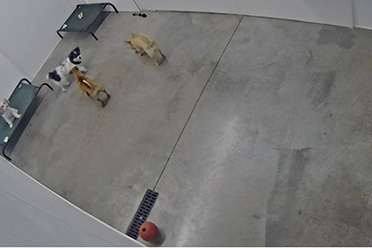
Owners at Paws Life can check the free HD webcams from their phone during the day. You can see the live webcams.
The hardest skill for owners is telling a dog having a great time from one winding up past the point of fun. The signals overlap, so read them as a pattern, not a single cue.
Healthy play usually shows:
Overstimulation usually shows:
The single most useful question is not "are they playing?" but "can they stop?" A dog that can pause, shake off, and re-engage is regulating itself. A dog that cannot is over-aroused and needs a break. ::: Developing this capacity for self-regulation early on provides a stable foundation for more structured socialization activities that help smaller breeds navigate complex interactions with confidence.
Arousal is a curve, not a switch. Once it climbs, it takes time to come down, and a dog that never gets a break will eventually tip into a scuffle or stress response.
A dog that seeks out the quiet space on its own is self-regulating, a good sign the environment permits rest. A dog never offered a rest option, or repeatedly pulled back into play when it tries to leave, is being set up to fail.
Live video is a learning tool, not just reassurance. Watch the pattern over a full session: does your dog play in bursts and rest in between, or stay pinned to the edge? Does it return to the handler or avoid people? Does it seek out the same compatible dog or get bounced between partners? Those patterns tell you more about fit than any single moment.
Group play is not right for every dog, and any provider that says otherwise is selling, not advising.
Pros:
Cons:
When group play is a poor fit: dogs with severe reactivity, dogs recovering from injury, and dogs that show sustained fear in a group. For those dogs, solo care or a structured boarding suite is the kinder choice. Puppies and seniors can do well, but they need smaller groups and more rest.
Ask questions before you hand over the leash. A good provider answers without flinching.
Vaccine requirements and temperament test details vary by facility, so confirm them directly. You can review the new client requirements and our daycare and boarding FAQ for specifics.
The only way to know if a playgroup suits your dog is to try it with people who know what to watch for.
We keep it simple: a free half-day temperament test, suite-style boarding with elevated beds for overnight stays, and free HD webcams so you can look in whenever you want.
Get started with Paws Life and book your dog's first visit today.
Supervised dog playgroups offer structured socialization, physical exercise, and mental enrichment in a controlled setting. Dogs learn healthy communication through play bows and appropriate corrections, build confidence, and release energy that might otherwise turn into boredom or destructive behavior. A 2016 Hunter College study found that dogs attending playgroup showed significantly fewer behavioral signs of stress, even when cortisol levels did not change. The key is trained supervision that matches dogs by size, play style, and temperament, so every session stays positive and low-pressure.
Safety starts with assessment. Good providers evaluate each dog's temperament and play style before grouping them, then match dogs by size and energy level. Trained handlers watch for stress signals like stiff body language, tucked tails, or mounting, and they interrupt play that escalates. Small groups, planned rest breaks, and clear escape routes in the play area all reduce risk. Ask whether staff are trained in dog body language and whether the facility separates dogs by size and play style. At Paws Life, over 25 years of managing social playgroups means handlers know when to guide play and when to let dogs rest.
Group play is not right for every dog. Overstimulation, exhaustion, and stress can affect dogs that prefer quiet or need more personal space. Some dogs become overly aroused in large groups, and without proper supervision, play can turn into bullying or scuffles. Illness can spread in any group setting, so vaccination requirements matter. The honest pros and cons of dog daycare come down to fit: a well-run playgroup with trained supervision and rest periods suits many social dogs, while reactive or anxious dogs may do better with smaller sessions or one-on-one care. A trial visit helps you see how your dog responds.
Look for loose, bouncy movement, play bows, and a wagging tail during greetings. A happy dog returns to play after brief pauses, takes water breaks, and greets other dogs with relaxed body language. Warning signs include tucked tails, stiff posture, hiding, excessive panting without heat, or trying to leave the play area. Many facilities offer webcams so you can watch live. At Paws Life, free HD webcams let you check in during the day and see whether your dog is playing, resting, or seeking attention from staff. A dog that comes home tired but calm is a good sign the session matched their energy.

25
Nov
Supervised dog playgroups build social skills and confidence. Learn how safe playgroups work, what t...
Read More
25
Nov
Personalized pet sitting care from local experts keeps your pet comfortable with custom routines and...
Read More.jpg?maxwidth=369&maxheight=217&mode=crop&anchor=center)
25
Nov
Compare the best dog daycare centers in Cornelius NC, with pricing, temperament tests, vaccination r...
Read More© Paws Life All rights reserved | Mobile-ready websites by Web Station Inc.